
Choose a central heat pump if your home already has ductwork in good condition and you want to heat all rooms evenly. Choose a wall-mounted, or multi-zone, heat pump if you don’t have ductwork, live in a condo or multi-unit building, or want to heat the main rooms first at a lower cost.
Two systems, two logics
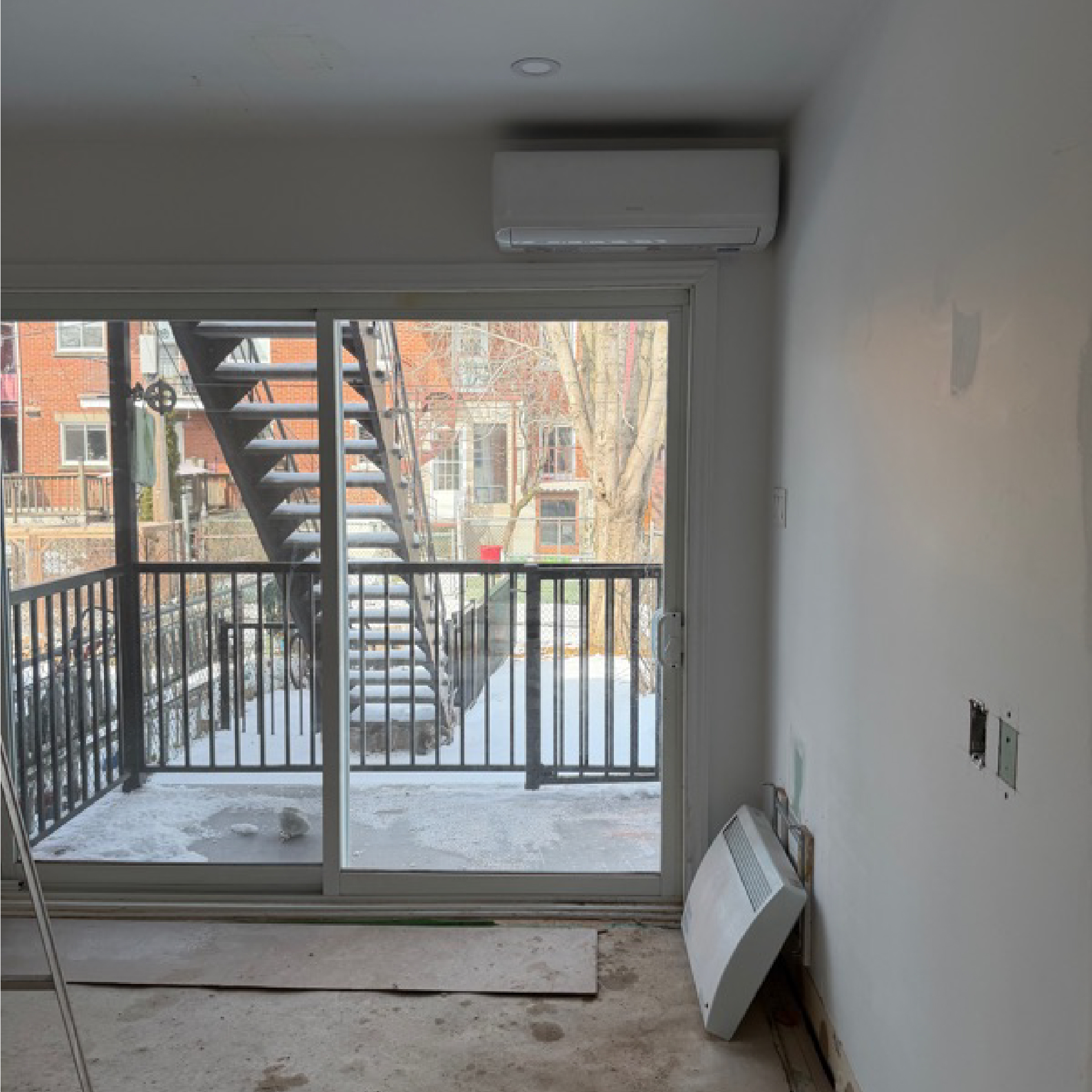
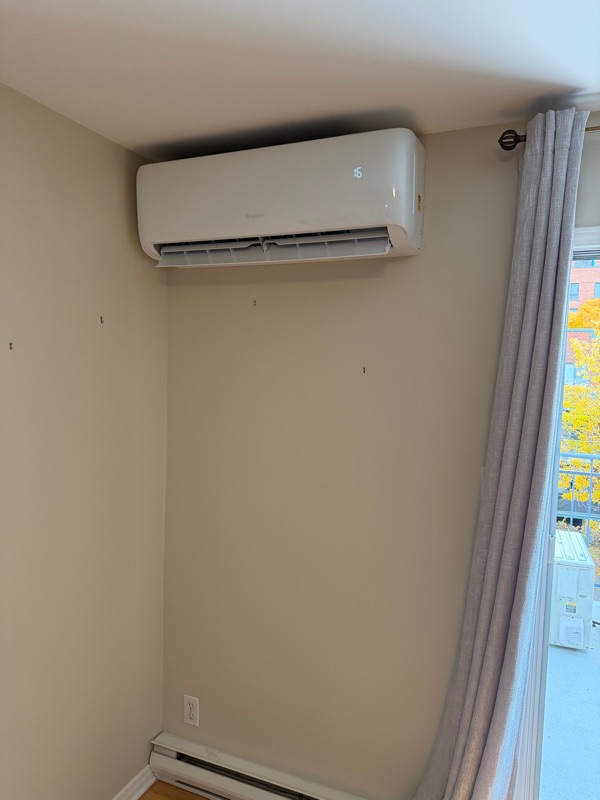
A wall-mounted heat pump (ductless mini-split system) connects an outdoor unit to an indoor unit mounted on the wall. It directly heats and cools the room where it is installed, or an open area. A multi-zone version connects several indoor units to a single outdoor unit.
A central heat pump (split system with ducts) replaces or supplements a furnace: the outdoor unit is connected to a coil and a fan placed in the air distribution system, and the heat circulates throughout the house through the ducts and grilles.
Comparative table: cost, comfort, efficiency, subsidy
| Criteria | Wall-mounted heat pump | Central heat pump |
|---|---|---|
| Necessary conduits | No | Yes, in good condition and well-sized. |
| Starting price | Replacement starting at $2,690 + tax at HVAC MTL, installation and 10-year warranty included | Price upon request: depends on the ductwork, the internal appliance, and the electrical system. |
| Heat distribution | Excellent in the room it serves, weaker in enclosed rooms | Uniform throughout all rooms connected to the ducts |
| Capacities offered in our catalogue | 9,000 to 36,000 BTU | 24,000 to 60,000 BTU |
| Air conditioning efficiency (SEER2) of our models | From 19 to 27.4 according to the product sheets | From 16 to 18.3 according to the product sheets |
| Heating up to (according to the manufacturer) | -25 °C or -30 °C depending on the range | -30 °C for the Stelpro Slim B and Ouellet Flexx models |
| Visibility | A visible unit on the wall in each area | Only the ventilation grilles |
| Eligible for LogisVert | Yes, if it is ENERGY STAR certified and has an outdoor unit of at least 12,000 BTU/h | Yes, under the same conditions, with exclusions specific to the conduits. |
The SEER2 values and minimum heating temperatures are taken from the wall-mounted and central heat pump datasheets in our catalogue.
The cost: what really weighs in the bill
A wall-mounted heat pump is almost always the least expensive option: an indoor unit, an outdoor unit, and piping through the wall. The cost of a central heat pump, on the other hand, depends primarily on what is already in place.
- With ducts in good condition and a recent furnace : adding a central heat pump can be done while retaining part of the existing system.
- Ducts that are too small or poorly insulated : they limit the airflow that a heat pump needs and sometimes need to be modified.
- No conduit required : building a complete network in an existing house is expensive and requires opening up walls and ceilings. A wall-mounted or multi-zone solution is therefore more practical.
For details on wall-mounted prices, read our article on the price of a wall-mounted heat pump installed in 2026 .
Comfort: uniformity versus targeted efficiency
A wall-mounted heat pump is very efficient in an open-concept living area. In a house with enclosed rooms, however, the more distant bedrooms tend to stay cooler, and your baseboard heaters take over. This is often acceptable: many homeowners primarily want to heat the living room, kitchen, and dining room, where they spend most of their time.
A central heat pump distributes air to all rooms connected to ductwork. It’s suitable for multi-story homes and bungalows with basements that already have a ventilation system. A multi-zone system falls somewhere in between: one unit per room or zone, without ductwork, and with individual temperature control for each zone. To determine how many units you’ll need, see Multi-zone Heat Pump: How Many Units?
Efficiency: how to read SEER2 and HSPF2
SEER2 measures seasonal efficiency in cooling; HSPF2, seasonal efficiency in heating. The higher these numbers, the less energy the unit consumes for the same workload. In our catalog, wall-mounted models have higher SEER2 ratings than central models, partly because they don’t have ducts where air and heat are lost.
Two important nuances:
- HSPF2 depends on the climate region used for the calculation. Natural Resources Canada explains that region V covers most of southern Canada, while published figures are often for the milder region IV. Always compare values from the same region.
- For ENERGY STAR “cold climate” certification, the ENERGY STAR 6.2 specification requires an HSPF2 of at least 8.5 for a ductless system and at least 8.1 for a ducted system, in addition to a COP of at least 1.75 at −15 °C (5 °F) (verified October 16, 2026).
The LogisVert subsidy: same rates, different exclusions
LogisVert accepts both central (split) and wall-mounted (mini-split) heat pumps at the same rate: $50 per 1,000 BTU/h of heating at -8°C for an ENERGY STAR® unit, and $120 for an ENERGY STAR® cold-weather unit (verified October 16, 2026). Since central heat pumps often have a higher capacity, the total amount may be higher, up to a maximum of 100% of the pre-tax cost.
The LogisVert participation guide does, however, include exclusions that primarily affect central systems: indoor units or ducts located outside the insulated building envelope, for example in the attic, are not eligible, nor is a central heat pump installed in a house already equipped with a geothermal system. Our heat pump grant page summarizes all the conditions.
Our 5-question decision grid
- Do you have ducts in good condition? Yes: a central unit becomes a serious option. No: wall-mounted or multi-zone.
- Do you live in a condo or a multi-unit building? A mural is often the only realistic solution; also check the condo association’s rules.
- Is your house open plan? One or two wall units may be sufficient.
- Do you have several enclosed rooms to heat? Consider a central heating system if you have ducts, otherwise a multi-zone system.
- Are you replacing a furnace or a central air conditioner? The central system often allows for the reuse of existing infrastructure.
Frequently Asked Questions
Can a wall-mounted heat pump heat an entire house?
In a small house or open-plan apartment, yes, to a large extent. In a house with closed rooms, a single wall unit primarily heats the area where it is installed; other rooms require additional units or their existing heating.
Is a central heat pump more efficient than a wall-mounted one?
Not necessarily. In our catalog, wall-mounted models have higher SEER2 ratings than central models. Central units primarily offer better heat distribution when ductwork is already in place.
Are both types eligible for LogisVert?
Yes, if the unit is new, ENERGY STAR certified, with an outdoor unit of at least 12,000 BTU/h, and installed by a contractor holding the correct RBQ license. Ducts located outside the insulated building envelope are excluded.
Can you keep your furnace with a central heat pump?
Yes, this is a common setup: the heat pump provides heating most of the time, and the furnace takes over in very cold weather. The choice depends on your current energy source and the condition of your furnace.
Are you hesitating between the two? We’ll assess your home and suggest the most sensible solution. Get your quote in less than 24 hours or call us at 438.816.0992.