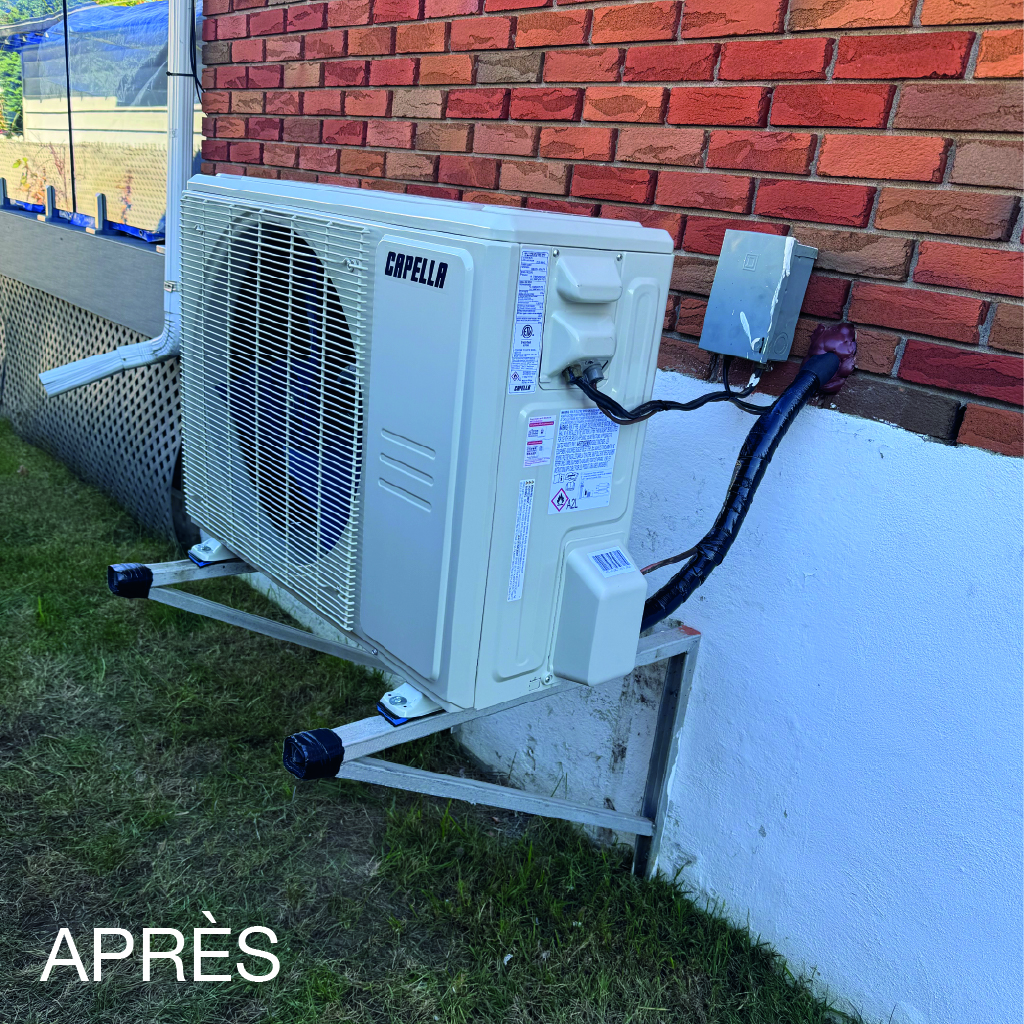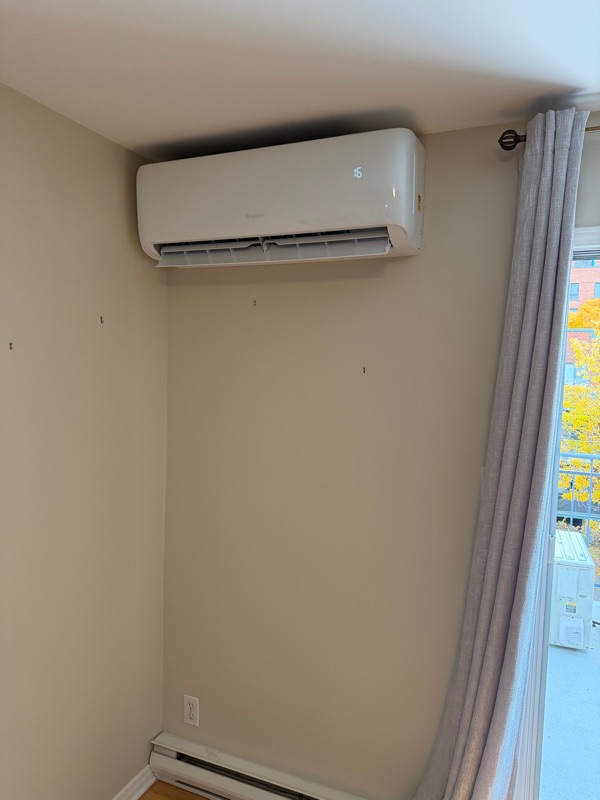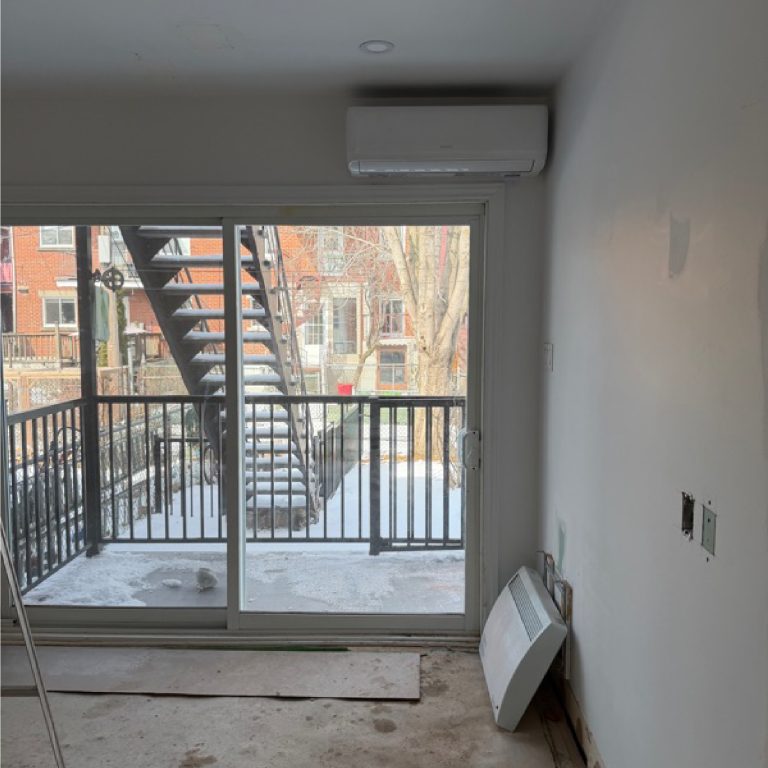
For a preliminary estimate, locate the room’s area in the ENERGY STAR table (for example, 450 to 550 sq ft ≈ 12,000 BTU/h), then adjust for sunlight exposure, whether there’s a kitchen, and the number of occupants. This table is for air conditioning; for heating in Quebec, an assessment of heat loss is still essential.
Surface area → BTU
The most commonly used table is the ENERGY STAR table for room air conditioning (accessed October 16, 2026). It gives the recommended capacity based on the area to be air-conditioned.
| Area (sq ft) | Recommended capacity (BTU/h) |
|---|---|
| 100 to 150 | 5,000 |
| 150 to 250 | 6,000 |
| 250 to 300 | 7,000 |
| 300 to 350 | 8,000 |
| 350 to 400 | 9,000 |
| 400 to 450 | 10,000 |
| 450 to 550 | 12,000 |
| 550 to 700 | 14,000 |
| 700 to 1,000 | 18,000 |
| 1,000 to 1,200 | 21,000 |
| 1,200 to 1,400 | 23,000 |
| 1,400 to 1,500 | 24,000 |
| 1,500 to 2,000 | 30,000 |
| 2,000 to 2,500 | 34,000 |
Corrections to be applied
ENERGY STAR recommends adjusting the result according to room conditions:
- Very shaded room : reduce capacity by 10%.
- Very sunny room : increase capacity by 10%.
- More than two regular occupants : add 600 BTU/h per additional person.
- Cooking : add 4,000 BTU/h.
The calculation method, step by step
- Measure the area to be served : length × width of each room open to the unit, in feet. A room closed by a door will only partially benefit from the device.
- Add up the areas of the open space. Example: living room 16 × 14 ft = 224 sq ft, dining room 12 × 12 ft = 144 sq ft, open kitchen 12 × 10 ft = 120 sq ft; total 488 sq ft.
- Read the table : 488 sq ft is between 450 and 550 sq ft, or 12,000 BTU/h.
- Apply the corrections : the kitchen is part of the zone, so +4,000 BTU/h; if the room is very sunny, +10%.
- Round up to the model offered : wall-mounted heat pumps are generally available in 9,000, 12,000, 18,000, and 24,000 BTU capacities. In our example, the cooling calculation points to an 18,000 BTU model, to be confirmed by the heating assessment.
Second example: a closed room
- Room of 11 × 12 ft = 132 sq ft.
- The table gives 5,000 BTU/h for 100 to 150 sq ft.
- South-facing room, very sunny: +10%, i.e. 5,500 BTU/h.
- The smallest common wall-mounted model is 9,000 BTU: it more than covers the air conditioning needs of this room.
This example illustrates a limitation of the calculation: for a small room, the smallest model is often more than sufficient. If several small, enclosed rooms need to be served, a multi-zone system with one head per room is often more practical than one unit per room.
The information that allows for an accurate calculation
To recommend a power rating for you, we need:
- the surface area and ceiling height of the rooms to be served;
- the type of accommodation (condo, plex, house) and the floor;
- the age of the building and the condition of the insulation and windows;
- the orientation of the large windows;
- the existing heating system, which will serve as a supplement during periods of extreme cold.
Why heating changes everything in Quebec
The ENERGY STAR rating system is for air conditioning. In Montreal, heating is the real limiting factor: in January, the temperature difference between inside and outside is much greater than in July. Two key points to remember:
The recognized method: the CSA F280 standard
Natural Resources Canada recommends determining heating and cooling loads using a recognized method such as the CSA F280-12 standard, taking climate into account. This calculation incorporates wall and roof insulation, windows, airtightness, and orientation. It is best to reduce heat loss first: a better-insulated house can use a smaller unit.
Rated power decreases in very cold weather
The figure “12,000 BTU” is a rated output. In cold weather, the heating capacity decreases on most units. The GREE Vireo brochure illustrates this: the 12,000 BTU model delivers 7,700 BTU/h of heating at -8°C under certification conditions. Natural Resources Canada reminds users that below the thermal equilibrium point, supplemental heating takes over, and an undersized unit will cause it to operate more frequently.
Too big, too small: the two mistakes
| Error | Consequences |
|---|---|
| Device too small | Runs continuously in very cold weather, setpoint not reached, auxiliary heating activated |
| Device too big | Higher purchase price, shorter cycles, less effective dehumidification in summer, less stable comfort |
Benchmarks for Montreal housing
- Closed bedroom or office : often 9,000 BTU; note that a 9,000 BTU model is not eligible on its own for LogisVert, which requires an outdoor unit of at least 12,000 BTU/h.
- Open area of a condo : 12,000 to 18,000 BTU depending on the area, windows and floor.
- For a single-room apartment (plex) : a multi-zone heat pump with one unit per zone is often more efficient than a single large unit. See how many units are needed for a single-room apartment .
You can compare the capacities offered in our heat pump catalog , from 9,000 BTU for a single room to 60,000 BTU for a central system. The power output also influences the price: see our article on the price of an installed wall-mounted heat pump .
Frequently Asked Questions
How many BTUs for 500 sq ft?
According to the ENERGY STAR chart for air conditioning, 450 to 550 sq ft corresponds to 12,000 BTU/h, before adjustments. For heating in Quebec, have this result verified based on insulation and windows.
Should a heat pump be sized for heating or air conditioning?
Natural Resources Canada recommends considering climate and heating and cooling loads. In Quebec, heating needs are generally the determining factor.
Does a 12,000 BTU heat pump heat 12,000 BTU/h in very cold weather?
Generally not. Capacity decreases with outside temperature. For example, the GREE Vireo 12000 brochure indicates 7700 BTU/h at -8°C under certification conditions.
Can I install a more powerful heat pump “just in case”?
This is not recommended: an oversized device costs more, operates in short cycles and controls humidity less well in summer.
Do you want a quote tailored to your home? Get your price : we’ll assess your power needs and get back to you in less than 24 hours. Phone: 438.816.0992.