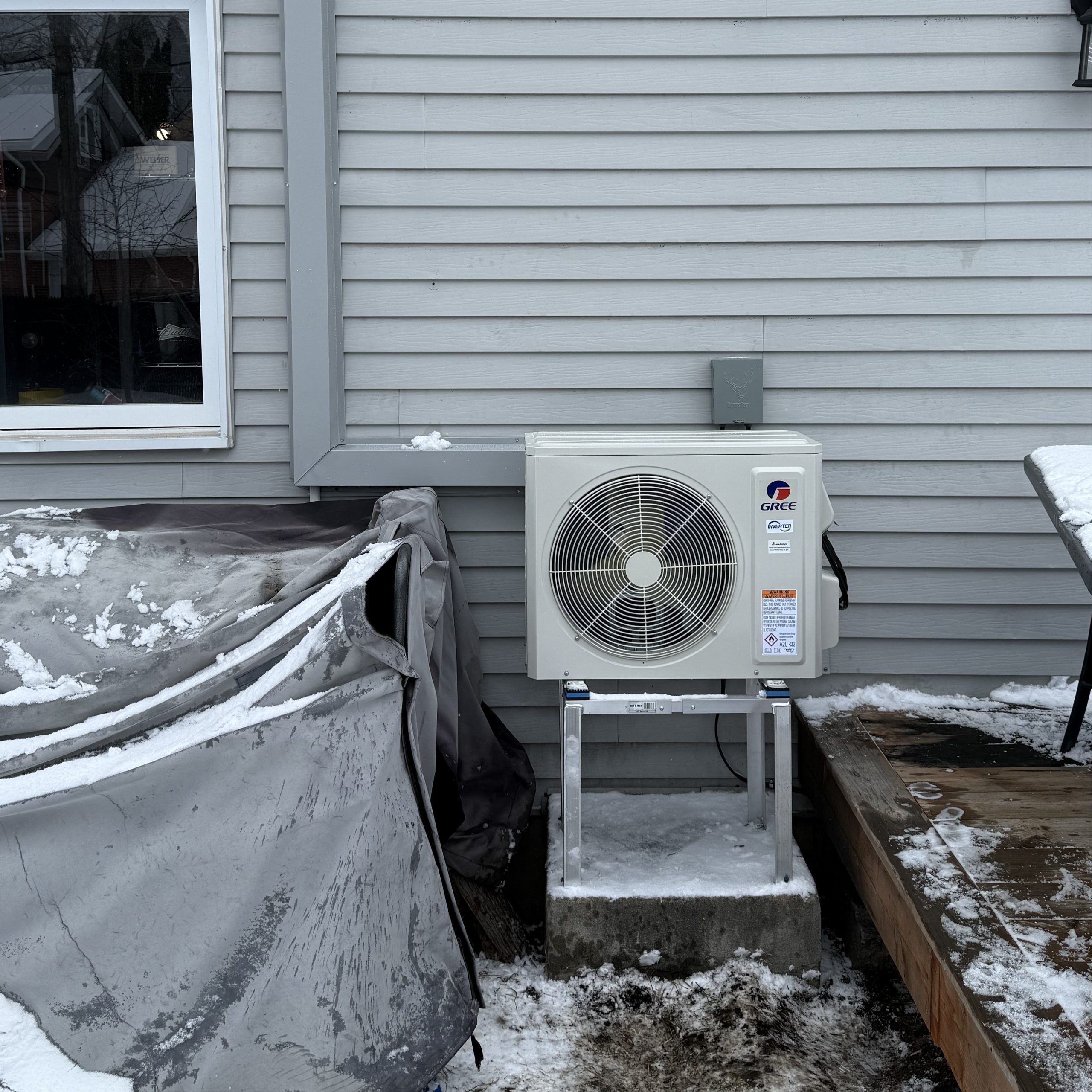
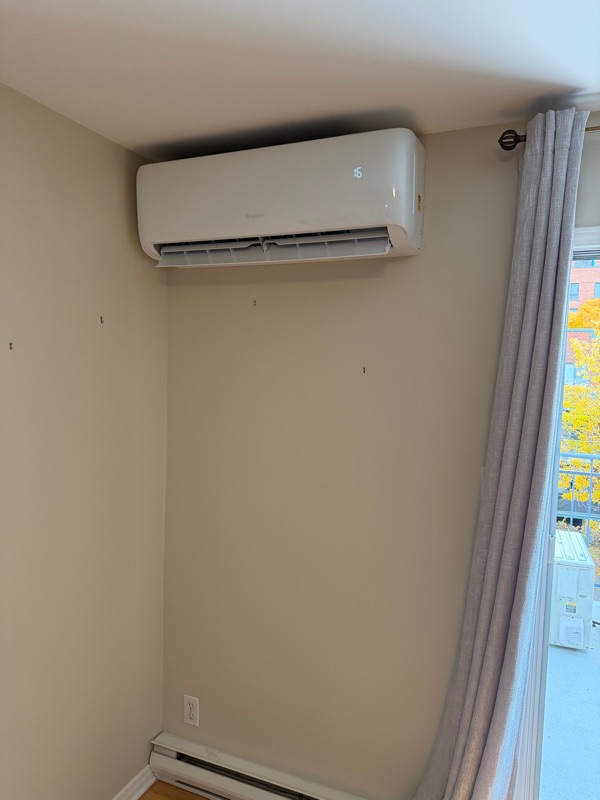
Most Gree heat pump problems stem from a clogged filter, incorrect settings, a blocked drain, or an electrical fault. When the unit displays a code, Gree indicates, for example, that E1 signifies high pressure, E5 an overcurrent, F1 to F5 a sensor issue, and H1 a defrost cycle in progress, which is normal.
First of all: identify your Gree model
Gree manufactures many product lines, and the meaning of a code can vary from one generation or display to another. Note the model number on the outdoor unit’s nameplate before looking up a code. Among the Gree heat pumps we install in Montreal are the Livo, Vita, Vireo, and Crossover wall-mounted models, as well as the Freematch multi-zone systems. According to the manufacturer, the Livo and Vita heat pumps heat down to -25°C, and the Vireo, Crossover, and Freematch heat pumps down to -30°C.
Your appliance manual remains the definitive reference for your specific model. The table below only lists the codes described by Gree in its “GREE Mini-Split Error Codes” guide published by GREE Comfort (accessed October 16, 2026).
Gree error code table
| Code | Meaning according to Gree | What you can check | Technician intervention |
|---|---|---|---|
| E1 | High pressure in the system | Coils and fans: cleanliness, debris, snow or ice on the outdoor unit | Checking the high-pressure switch and for possible refrigerant overload |
| E3 | Low pressure | Clogged filters and coils | Weighing the refrigerant charge and leak detection |
| E5 | Overcurrent protection | No internal manipulation; note if the power supply is unstable | Inspection and stabilization of the power supply |
| E7 | Conflict of modes between units | Set all units to the same mode (heating or cooling) | If the code persists |
| F1 | Indoor ambient temperature probe | Nothing to do yourself | Checking connections, replacing the probe |
| F2 | Indoor evaporator probe | Nothing to do yourself | Checking connections, replacing the probe |
| F3 | Outdoor ambient temperature probe | Nothing to do yourself | Checking connections, replacing the probe |
| F4 | Outer tube probe | Nothing to do yourself | Checking connections, replacing the probe |
| F5 | Backflow probe | Nothing to do yourself | Checking connections, replacing the probe |
| H1 | The appliance is defrosting. | Nothing: it’s a normal winter status code | Only if the defrosting process repeats endlessly or fails to melt the ice |
| H5 | Power Module Protection (IPM) | Nothing to do yourself | Service required according to Gree |
| C5 | Jumper problem | Nothing to do yourself | After a card replacement, transfer the jumper from the old card to the new one |
| U3 | DC bus voltage drop | Nothing to do yourself | Professional evaluation |
| L9 | Power protection mode, possibly after an overvoltage | Nothing to do yourself | Professional evaluation |
For probes (F1 to F5), Gree specifies that repair generally requires a technician to replace the component, after checking the connections, using manufacturer-approved parts. See a code that isn’t in this table? Don’t rely on a list found randomly online: codes vary by model. Take a photo of the display and the model number, and send them to your technician.
Common problems without error codes
The device blows warm air in winter
First, check the mode (heating, not fan-assisted or “auto”), the set temperature, and the condition of the filters. During defrosting, the indoor unit may stop blowing air for a few minutes: this is normal. If the air remains consistently lukewarm, the cause could be a lack of refrigerant, a faulty sensor, or a defrosting problem. Our guide for heat pumps that have stopped heating details these checks in order.
Water is leaking from the wall unit
Most often, the condensation tray or drain is clogged with dust or deposits. Water then overflows down the wall. Cleaning the tray and drain usually solves the problem; if it recurs, the drain’s slope should be checked.
Steam is coming out of the outdoor unit
In winter, it’s almost always the defrost cycle, often accompanied by the H1 code on models that display it. The phenomenon is explained in “Why my heat pump is ‘smoking’ in winter .”
The device no longer responds to the remote control
Change the batteries, check that nothing is blocking the indoor unit’s receiver, then turn the power off and back on at the circuit breaker. If the unit still does not start, there may be a problem with the power supply or the electronic board.
The outdoor unit is frozen.
A thick layer of ice that doesn’t melt after defrosting can be caused by a unit installed too low, a defrost water draining too quickly, or a leak from the roof. Do not break the ice with a tool; you risk puncturing the coil.
The circuit breaker trips
If the heat pump circuit breaker trips repeatedly, do not reset it indefinitely. Turn off the power and have the electrical installation and compressor checked.
Resetting a Gree heat pump: only needs to be done once
- Turn off the device with the remote control.
- Turn off the power at the circuit breaker or the outdoor disconnect switch.
- Wait a few minutes, then restore the power.
- Restart in heating mode and observe the device for about fifteen minutes.
If the same code recurs, resetting it only masks the problem. A recurring pressure (E1, E3) or electrical (E5, H5, U3, L9) code requires diagnosis. Running the unit continuously on a protected circuit can damage the compressor.
Information to note before calling a technician
A good diagnosis starts over the phone. Before calling us, please take a minute to note down:
- The displayed code, or the number of flashes of the indicator light if the device does not have a screen.
- The model and serial number are inscribed on the plate of the outdoor unit.
- The mode used and the setpoint temperature at the time of the problem.
- The approximate outside temperature and the presence of snow or ice on the unit.
- What you have already tried: cleaning the filters, resetting, changing the batteries.
- The installation date and the installer’s name are useful for the warranty.
With this information, the technician arrives with the right parts more often and the repair is faster.
Preventing problems on a Gree heat pump
Most pressure codes and running water problems have a common cause: a clogged unit. Clean the filters regularly, keep the outdoor unit clear of leaves and snow, and have it professionally serviced once a year. Our service includes cleaning the coil, impeller, and drain, taking pressure readings, and checking the defrost cycle, which often helps detect a worn sensor or a small leak before it breaks down.
Gree Warranty: What you need to know before a repair
The Gree models we install are covered by a 10-year warranty on the compressor and parts. The labor warranty varies by model: for example, our specifications indicate 10 years for the Crossover range and 1 year for the Livo, Vita, and Vireo ranges. Before having your unit repaired, keep your installation invoice and proof of maintenance: many manufacturers require regular servicing.
Frequently Asked Questions
What does the H1 code mean on a Gree heat pump?
According to Gree, H1 indicates that the appliance is in defrost mode. This is a normal status code in cold weather. It only becomes a problem if the defrost cycle repeats continuously or fails to melt the ice.
What does the code E1 mean?
Gree indicates that E1 signals high pressure in the system. Check that the coils and fans are clean and unobstructed; if so, a technician should check the pressure switch and refrigerant charge.
Can I replace an F1 to F5 sensor myself?
No. Gree specifies that these codes generally require the component to be replaced by a qualified technician, after verification of the connections, with approved parts.
Do you repair Gree heat pumps that you did not install?
Yes. We repair and maintain heat pumps of all brands in Montreal, Laval and on the South Shore, regardless of who installed them.
Is your Gree heat pump displaying a code or not heating properly? Our heat pump repair service provides a fast diagnosis. Contact us or call 438-816-0992.