A heat pump that stops heating often has a simple cause: incorrect mode or setting, clogged filters, a defrost cycle in progress, or an outdoor unit blocked by snow. If these checks don’t resolve the issue, or if an error code is displayed, the problem is more likely technical: refrigerant, sensor, electrical, or compressor.
The diagnostic tree at a glance
Follow the questions in order. Each answer points you towards one of the nine causes detailed below.
- Is the indoor unit switched on and displaying anything? No: cause 1 (power supply, remote control).
- Is an error code displayed? Yes: cause 9 (error code).
- Is the mode set to “heating” and the setpoint above the room temperature? No: cause 2 (settings).
- Are the filters clean? No: cause 3 (filters).
- Did the indoor unit stop blowing for a few minutes, with steam outside? Yes: cause 4 (defrosting, normal).
- Is the outdoor unit covered in snow or ice? Yes: cause 5 .
- Is it colder than your model’s minimum temperature? Yes: cause 6 .
- The unit runs continuously, but the room remains cool? Causes 7 and 8 (sizing, refrigerant).
The 9 causes, from the simplest to the most technical
1. No power supply or silent remote control
Check the heat pump circuit breaker in the electrical panel and the disconnect switch near the outdoor unit. Change the remote control batteries. If the circuit breaker trips as soon as the unit restarts, do not repeatedly reset it: call a technician.
2. Wrong mode or wrong instructions
In “auto,” “ventilation,” or “dehumidification” mode, the unit is not heating as expected. Switch it to heating mode and set the temperature a few degrees above the current temperature. Also, check that a schedule or timer is not preventing it from shutting off. Avoid significant temperature drops at night: Natural Resources Canada recommends moderate reductions of no more than 2°C, as a heat pump raises the temperature more slowly than a furnace.
3. Clogged filters
A clogged filter reduces the flow of warm air and can trigger the unit’s safety features. Clean the filters in the wall unit, or replace the filter in a central system. Natural Resources Canada recommends doing this at least every three months. Also, check that furniture or curtains are not blocking the air intake and exhaust.
4. A defrost cycle is in progress
In cold, damp weather, frost forms on the outdoor coil. The unit then briefly reverses its cycle to melt it: the indoor unit stops blowing hot air for a few minutes, and steam is released from the outdoor unit. On some Gree models, the H1 code indicates defrosting, according to the manufacturer’s guide . This is normal, and heating resumes afterward. Everything is explained in the section “Why is my heat pump ‘smoking’ in winter ?”
5. Outdoor unit blocked by snow or ice
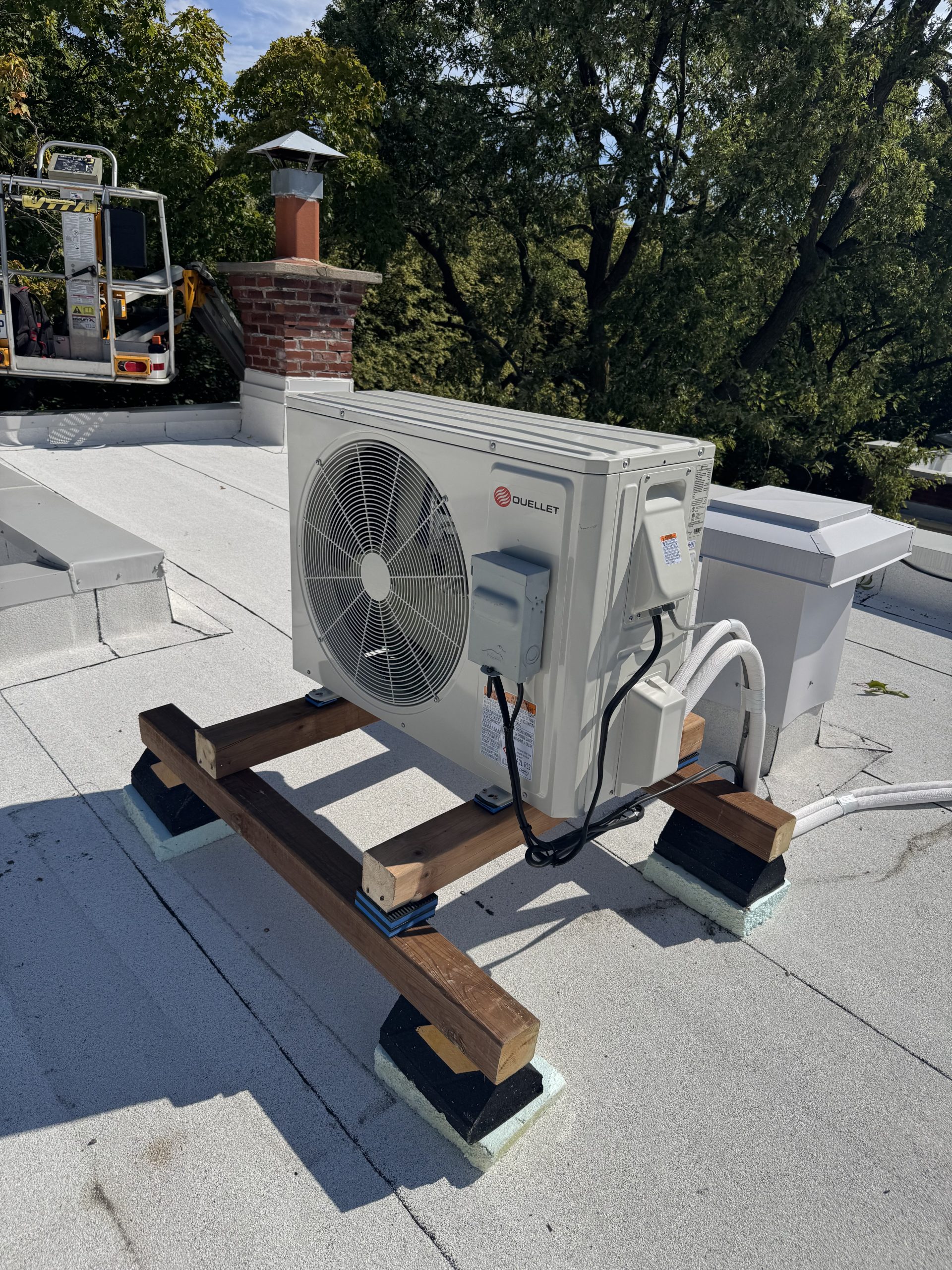
A unit buried or encased in ice can no longer absorb heat from the outside air. Gently clear the snow around and on top of the unit. If an ice block has formed under the unit or on the coil, do not break it with a tool: you could puncture a tube. Recurrent ice indicates a problem with drainage or the support is too low.
6. It is colder than the device’s limit
Each model has a heating operating range specified by the manufacturer. In our catalog, most wall-mounted models heat down to -25°C or -30°C. The colder it gets, the lower the heating capacity of most units becomes. Below this limit, the heat pump shuts off, and your backup heating system must take over.
7. An undersized device
If your heat pump runs at full power but never reaches the set temperature on cold days, it may be too small for your home’s size or insulation. Natural Resources Canada notes that with an undersized unit, the backup system will operate more frequently. Our heat pump BTU calculation guide can help you determine this.
8. A lack of refrigerant
A heat pump doesn’t “consume” its refrigerant: if it’s low, there’s a leak. Signs include: consistently lukewarm air, abnormal frost on the small pipe, and decreased performance from one season to the next. Only a refrigeration technician can measure the pressures, locate the leak, repair it, and recharge the system.
9. An error code: probe, board, compressor
A displayed code indicates that the appliance has detected a problem and has activated its protection mechanism. The temperature sensors, the electronic board, the fan, or the compressor may be the cause. Note the code and model number before calling. For Gree appliances, consult our Gree error code chart .
What you can do, what you should leave to the technician
| Cause | You can | Technician required |
|---|---|---|
| 1. Food | Check the circuit breaker and the batteries | If the circuit breaker trips repeatedly |
| 2. Settings | Correct the mode and the instructions | No |
| 3. Filters | Clean or replace | If the coil or turbine is clogged |
| 4. Defrosting | Wait for the end of the cycle | If the cycle repeats endlessly |
| 5. Snow and ice | Gently clear the snow | Recurring ice, support to be corrected |
| 6. Extreme cold | Use the auxiliary heater | No, except when stopping above the limit |
| 7. Undersizing | Observe behavior in extreme cold | Heating load assessment |
| 8. Refrigerant | Nothing | Yes, always |
| 9. Error code | Note the code and the model | Yes, if the code returns |
Preventing breakdowns next winter
Most heating problems are detected during fall maintenance: cleaning the coil and turbine, checking pressures, sensors, and the defrost cycle. Our 8-point checklist for preparing your heat pump for winter shows you what to check.
Frequently Asked Questions
Why is my heat pump blowing cold air in heating mode?
Most often, the unit is defrosting or has just started up and hasn’t yet heated its coil. If the air remains cold for more than a few minutes, check the mode, the temperature setting, and the filters, then have the refrigerant charge checked.
Is it normal for my heat pump to stop heating for a few minutes?
Yes, in cold and damp weather. During defrosting, the indoor unit stops blowing hot air and the outdoor unit may release steam. Heating then resumes.
At what temperature does a heat pump stop heating?
It depends on the model. Manufacturers indicate an operating range: the wall-mounted models we install heat down to -25°C or -30°C, with a capacity that generally decreases when it gets colder.
How much does it cost to repair a heat pump?
The price depends on the cause: cleaning is not the same as repairing a leak or replacing a compressor. We first diagnose the problem, then give you a price before carrying out any repairs.
Is your heat pump still not heating? Call our heat pump repair service in Montreal, Laval, and on the South Shore. Contact us or call 438-816-0992.